Everything you need to see and improve your AI visibility
Measure how AI assistants answer your buyers. Then see which pages they read and what to change on your own site.
What does the overview show?
The overview is the first screen after a measurement. It answers one question: how often do the engines name you, and who do they name instead?
AI visibility score
The share of AI answers that name your brand.
Share of voice
Your share of all brand mentions in those answers.
Rank among brands
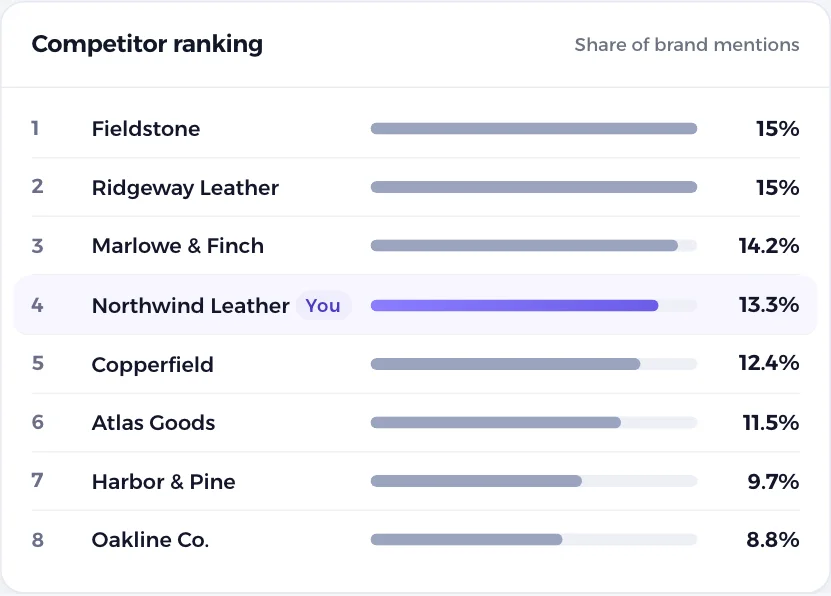
Where you stand among every brand the engines named.
Average position
Where you appear in the list when you are named.
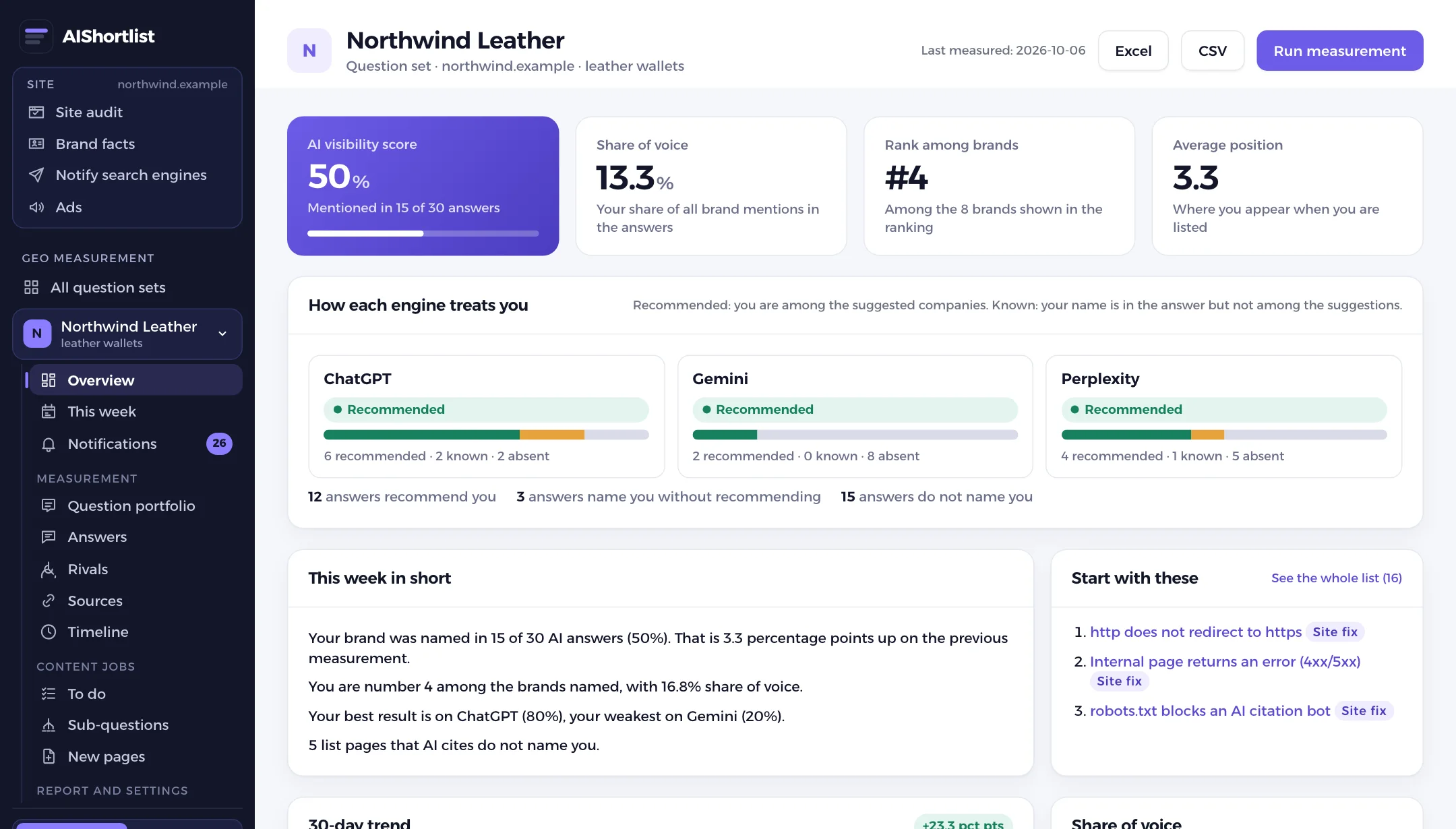
- 30-day trend
- Share of voice donut
- Visibility by engine
- Competitor ranking
- Question by engine matrix, with the quoted sentence
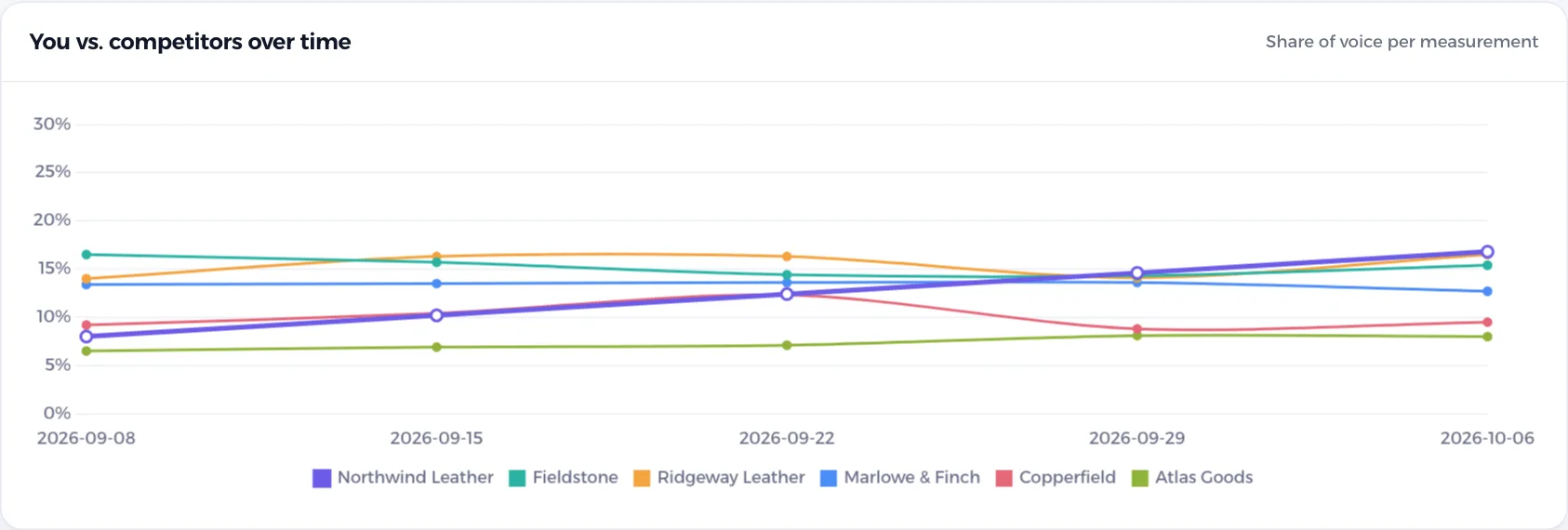
- You vs competitors over time
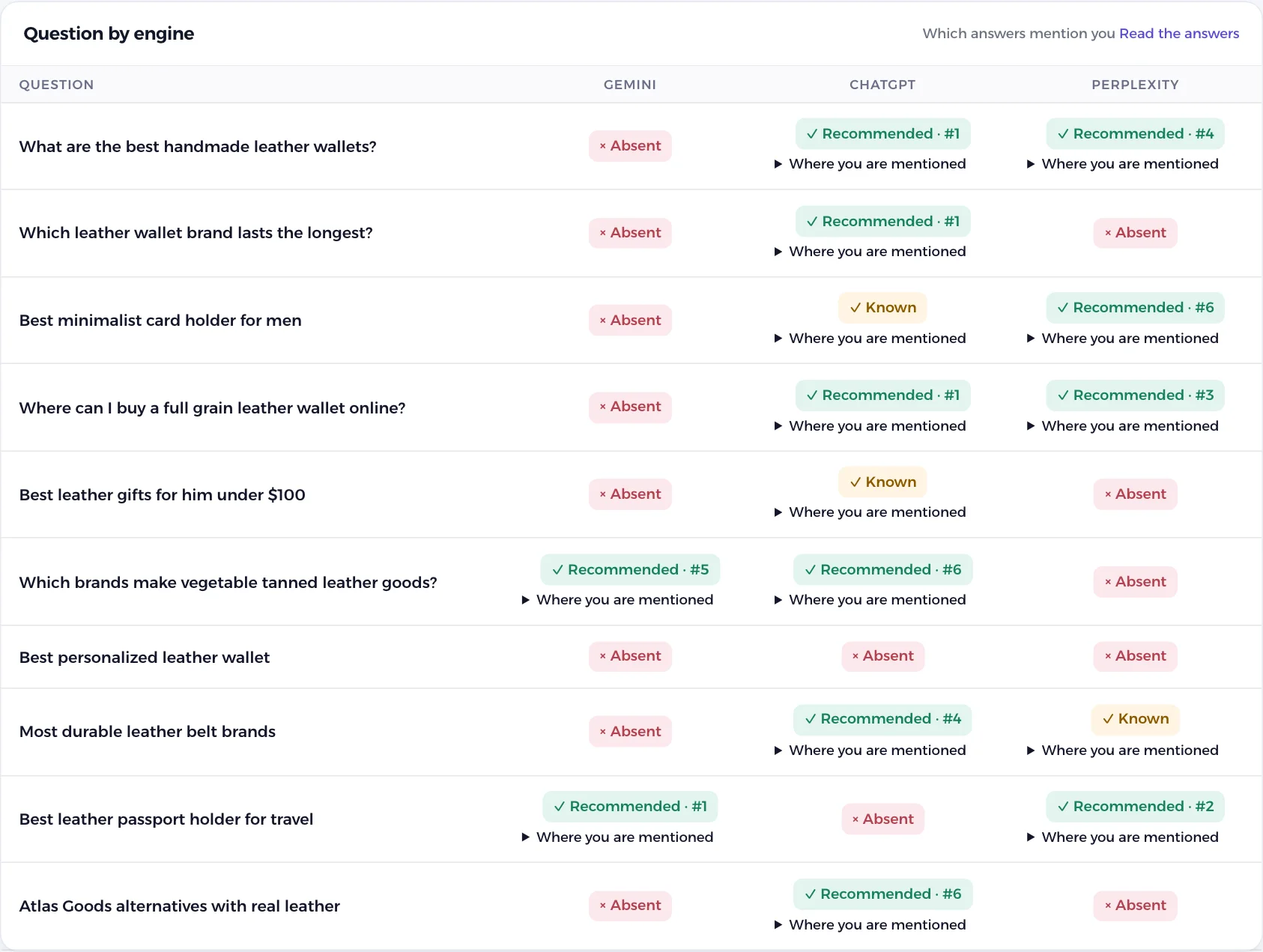
Which question did each engine answer with your name?
The matrix shows every question against every engine. Each cell says named or not, the position, and the sentence the engine wrote.
Are you gaining on your competitors?
"You vs competitors over time" plots your share of voice next to the brands named most often, measurement by measurement.
How does ChatGPT visibility tracking work? → How are the scores calculated? →
Which pages do the AI engines cite?
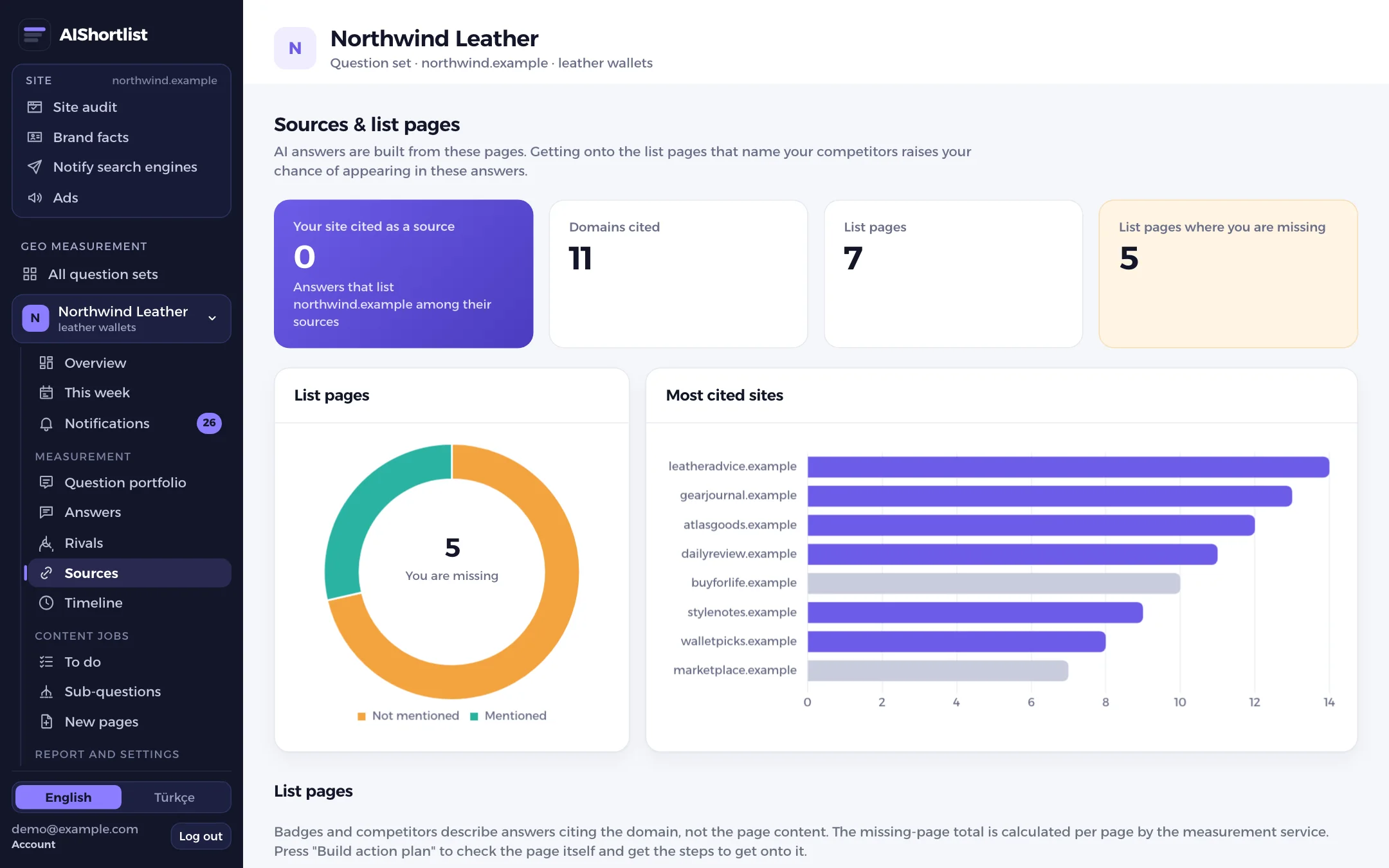
AI answers are built from web pages. Sources lists every domain the engines cited, marks the "best X" list pages among them, and shows where your brand is missing.
How do you get onto a list page?
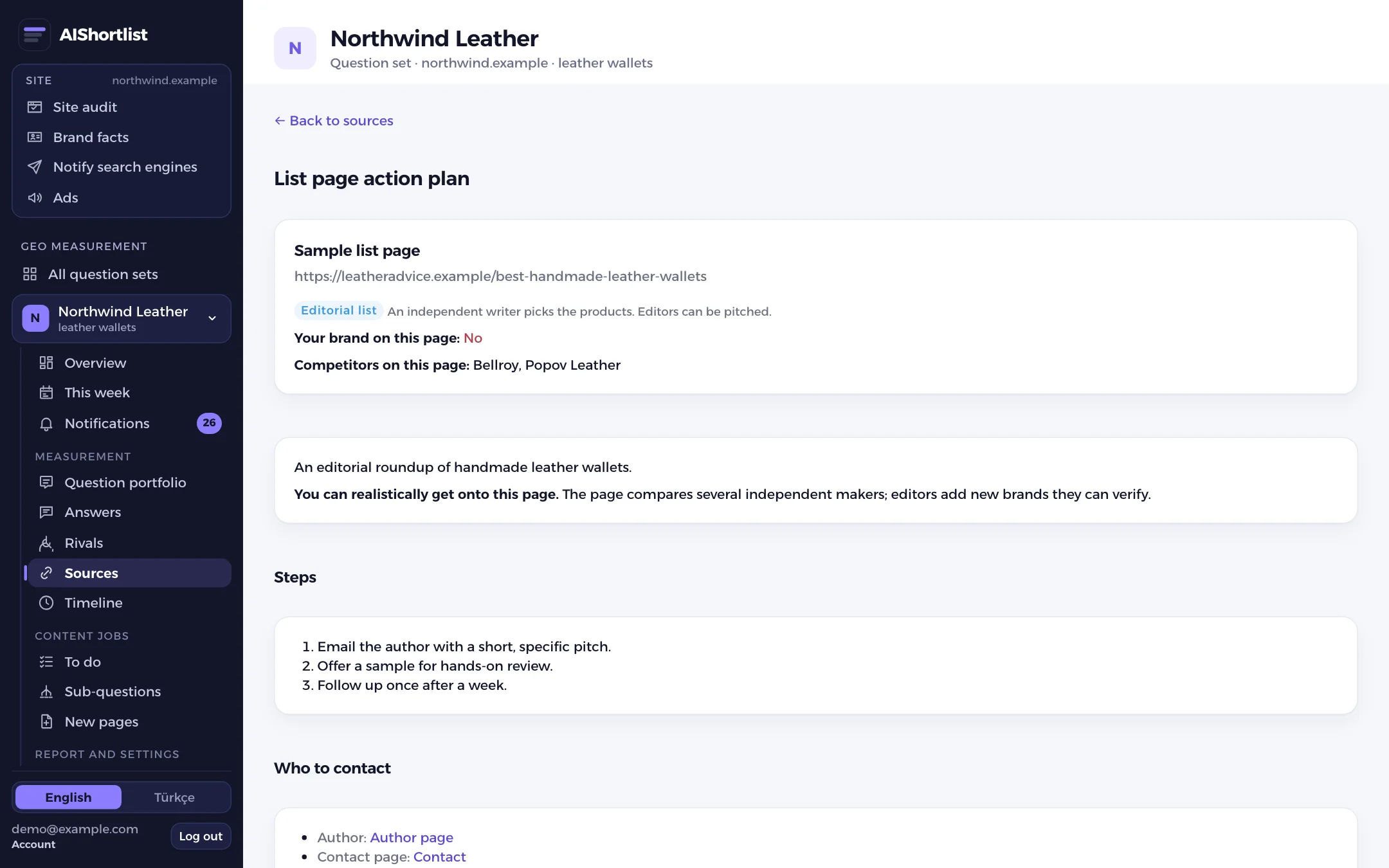
For each list page, one click builds an action plan. It reads the page itself and tells you:
- The page type: editorial list, competitor's own page, directory, marketplace or forum.
- Whether your brand is really on the page.
- Who to contact. Only routes found on the page, never guessed email addresses.
- Facts to send, quoted from your own site.
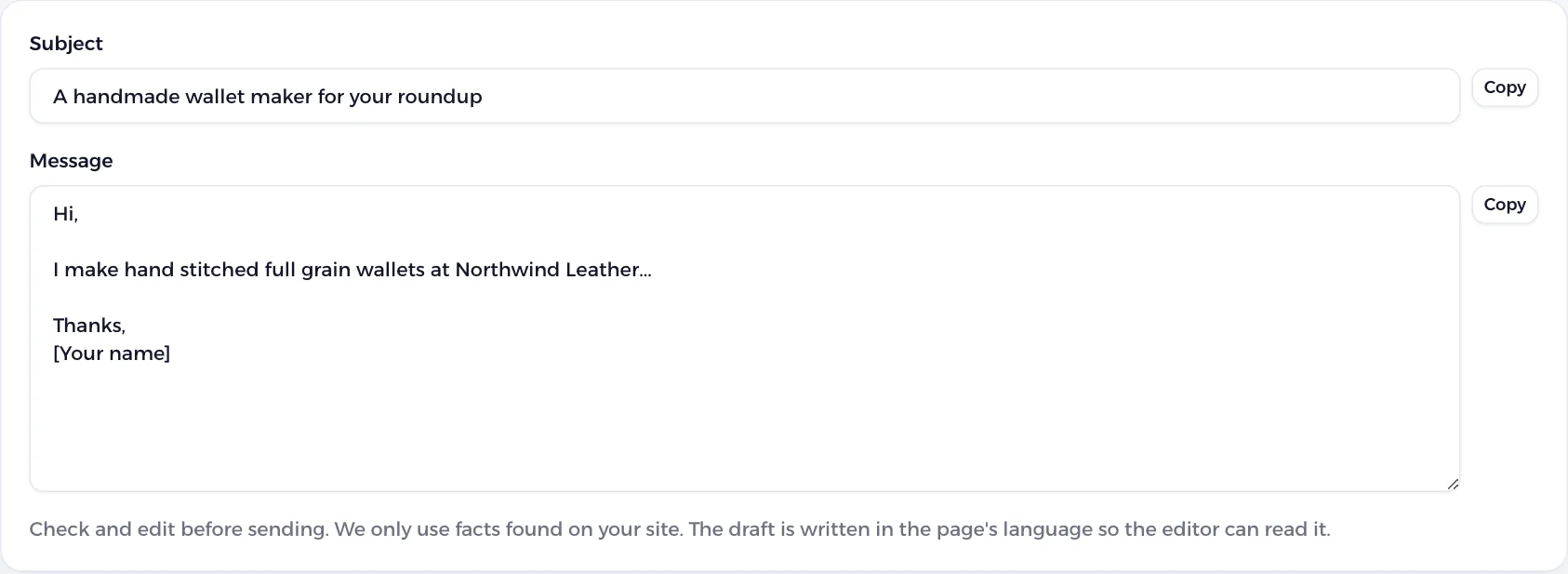
- A ready email draft in the page's language.
Sources shows the links given in the measured answers. These links are evidence for research; on their own they do not prove why a brand was recommended.
Can AI engines read your site properly?
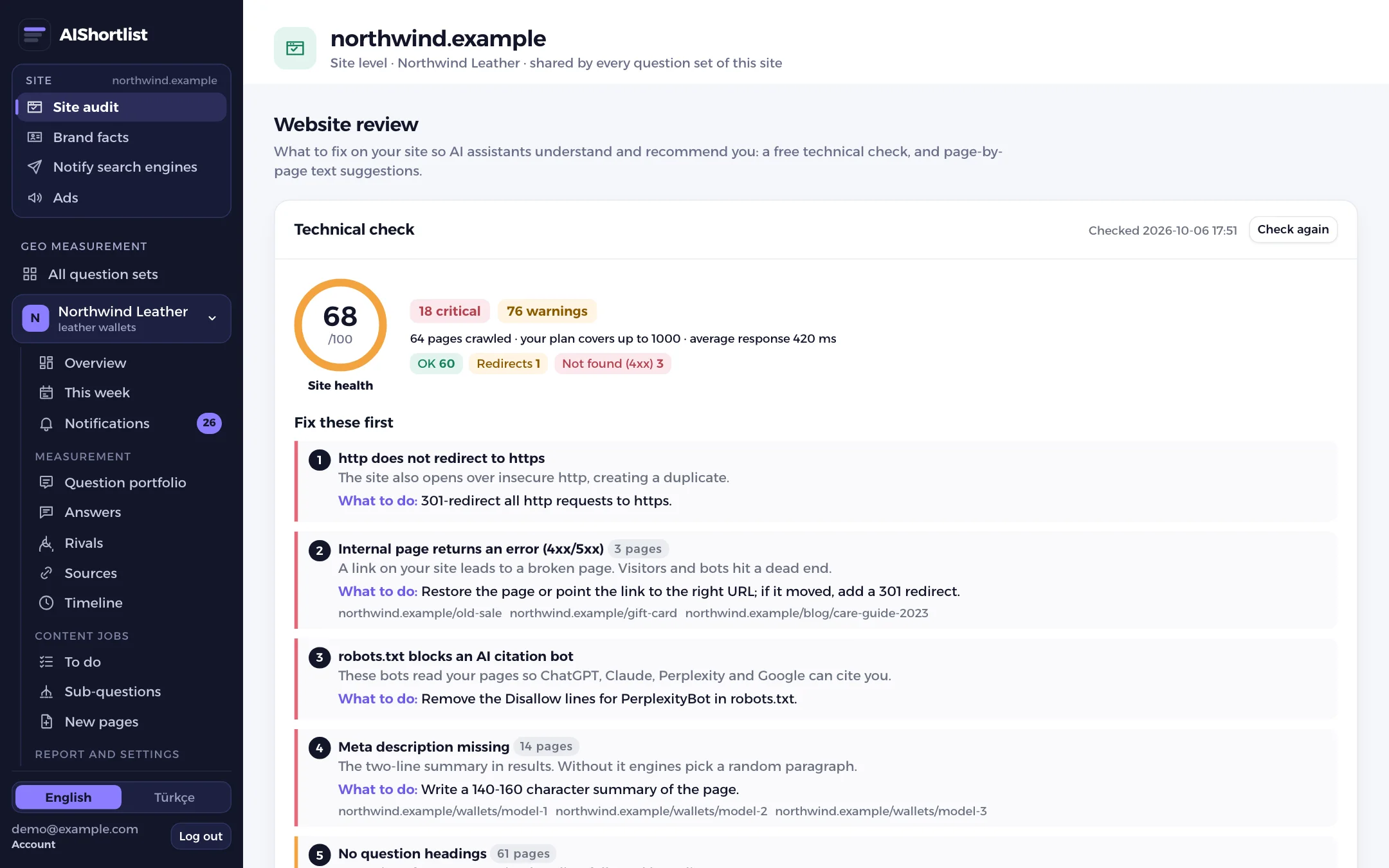
The site crawl starts by itself when you create a question set and is free on every plan. It follows your links up to your plan's page limit: 10 on the trial, 250 on Growth, 1,000 on Pro. You get a site health score from 0 to 100, the 5 things to fix first and "what to do" for each issue.
- Can AI bots read it (robots.txt, firewall, JavaScript)
- Page speed (Google PageSpeed)
- Broken pages and links
- Redirect chains
- Duplicate titles and descriptions
- Pages with no internal links
- Sitemap
- Canonical and schema
- Question headings and text length

What should you change on your pages?
Pick a page. AIShortlist reads it with your approved buyer questions in mind and suggests concrete edits.
- "Replace this passage with this" cards, before and after.
- New question and answer sections.
- A better title and meta description.
The rules behind every suggestion
- 1The passage to replace must exist on the page word for word.
- 2Numbers that are not on your site are removed.
- 3Missing facts are left as [blanks] for you to fill in.
- 4It does not correct a fact that is wrong or out of date on your site; you check before you publish.
Which sub-topics is your site missing?
AI search engines split a question into sub-questions and search for those; Google has said AI Mode works this way. AIShortlist lists the likely sub-questions for each question you approved and shows which ones your site already answers, with the page and an exact quote.
Example
“Recommend an agency in Istanbul that offers GEO”
- What does a GEO service include?
- How long until results show?
- How is the price set?
- How is it measured?
For each sub-question: answered on your site, partly, or not at all. For the missing ones, an "add this section" to-do and a draft text.
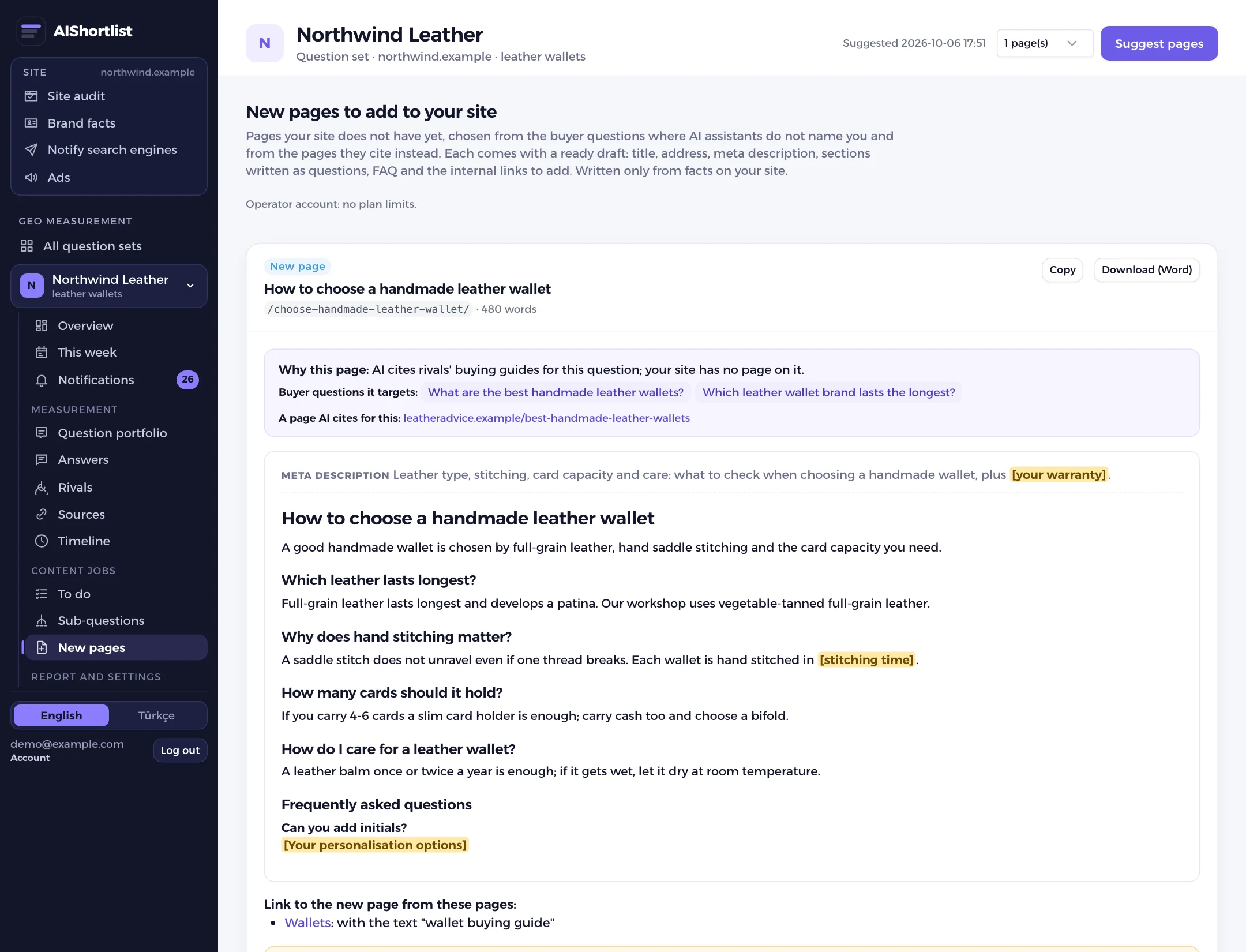
Which new pages should your site have?
The New pages screen finds the topics your buyers ask about that your site does not cover at all. It looks at the questions where AI does not name you and the rival or list pages it cites there, then suggests the pages to add, with the full text.
- Title and address: a title in the words buyers search, a ready slug.
- Why this page: the buyer questions it targets and the page AI cites for the topic.
- Full text: meta description, an intro that answers first, sections written as questions and an FAQ.
- Internal links: which of your existing pages should link to it, with which anchor text.
- Copy it or download it as a Word file.
The text uses only facts from your site. Numbers not found on your site become [number]; unknown facts wait in [brackets] for you to fill.
Which of these jobs comes first?
The to-do list gathers list pages, site problems, text suggestions, missing sub-questions and new pages into one prioritised list. You mark a job as done; the state of the related questions on that day is saved and the next measurement is shown beside it.
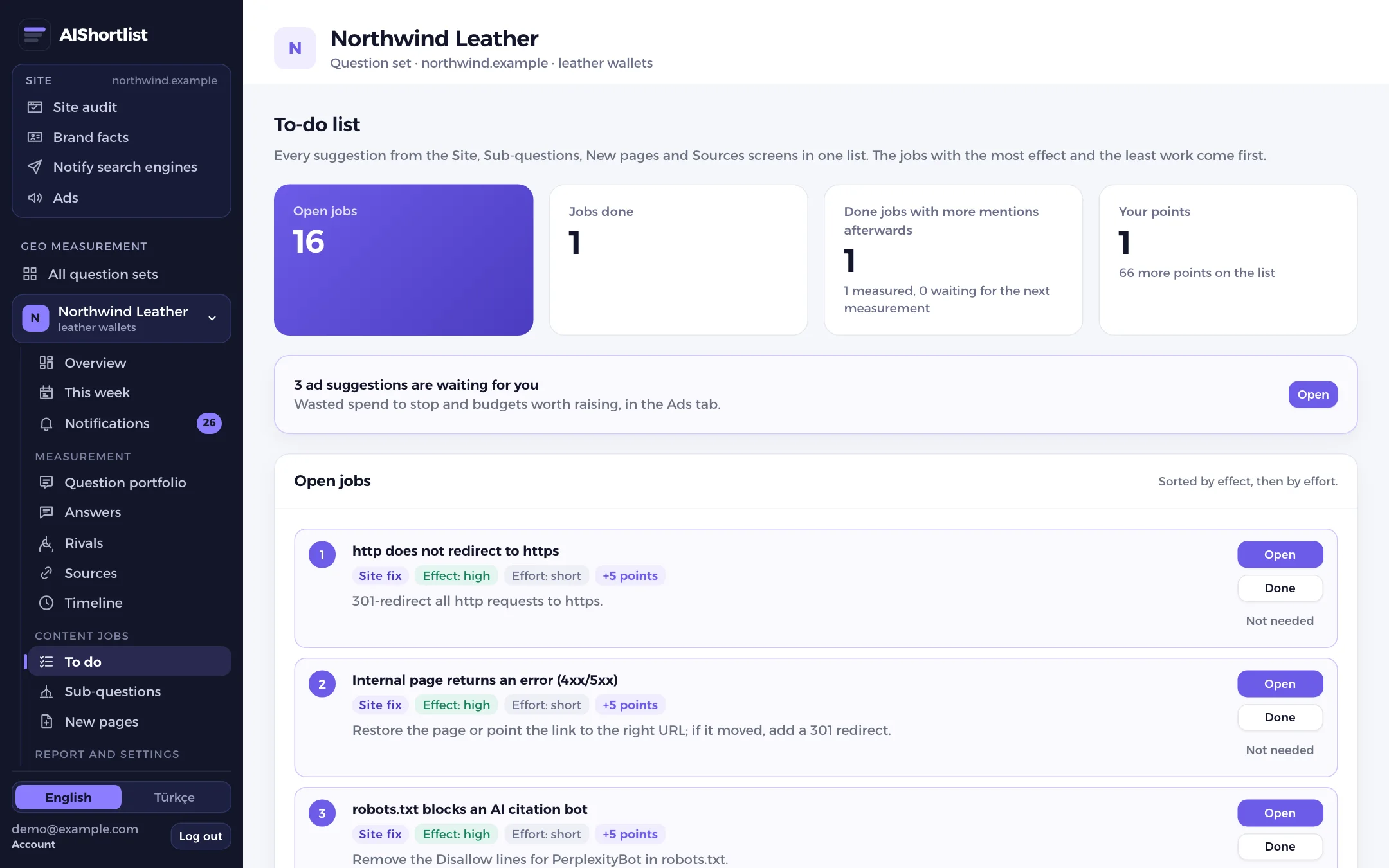
- The source screen and expected effect (high, medium, low) for each job.
- Mark as done or not needed.
- The measurement before and after a job, side by side.
AI answers also change from week to week on their own. A rise after a job is a good sign, not proof that the job caused it.
How do you share the results?
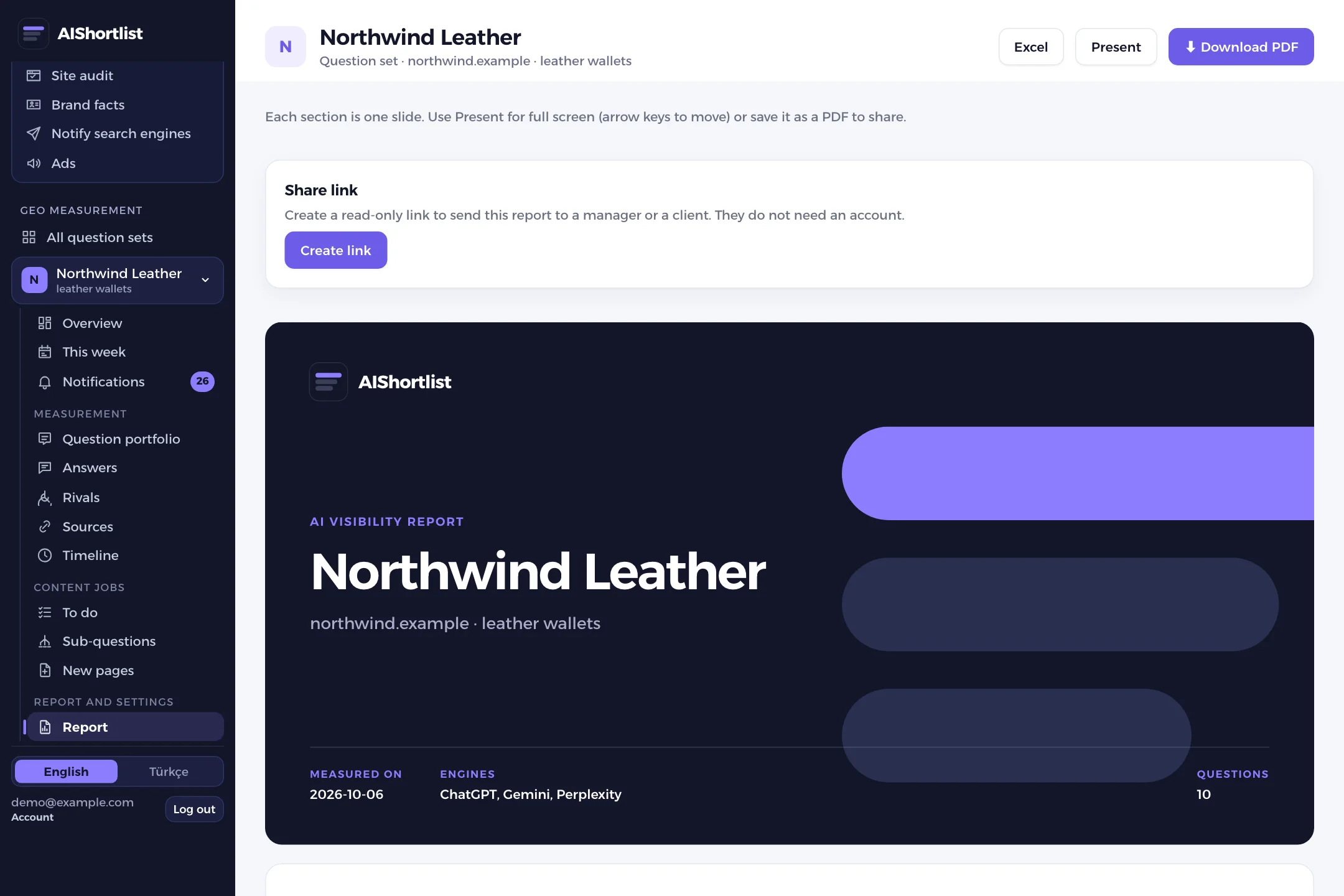
The report turns the measurement into slides. Press "Present" for full screen and move with the arrow keys. Or use "Download PDF".
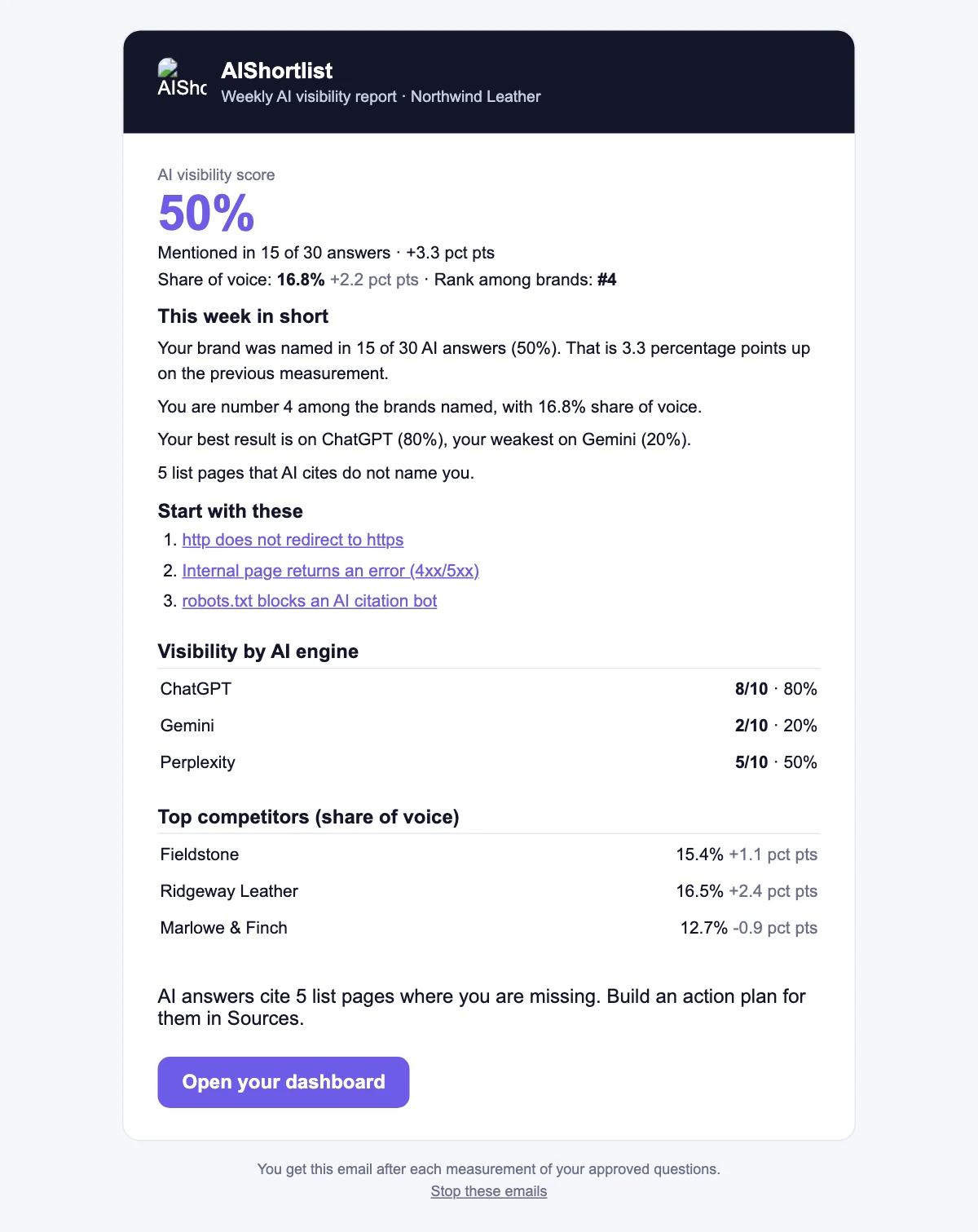
A weekly email after each measurement
Your score, the change since last time, visibility by engine and the top competitors. With a link back to the dashboard.
What exactly did the AI write about you?
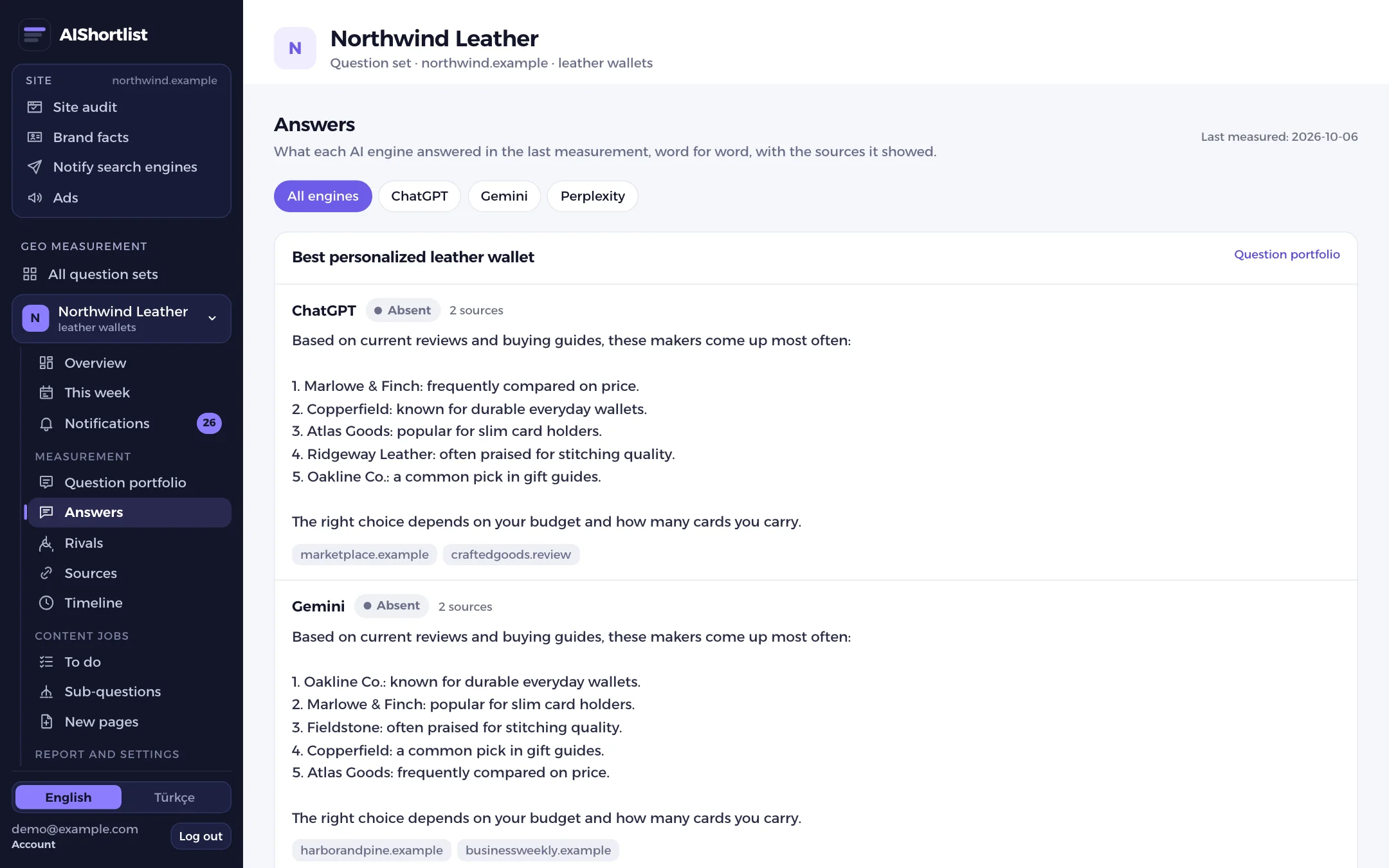
The Answers screen shows the full answer of every engine to every question in the last measurement. You read the text behind the score yourself. For each engine you see one of three levels: recommended, known or absent.
- The full answer text and its cited sources for every question and engine.
- Three levels: is your name among the suggestions, only mentioned, or not there at all.
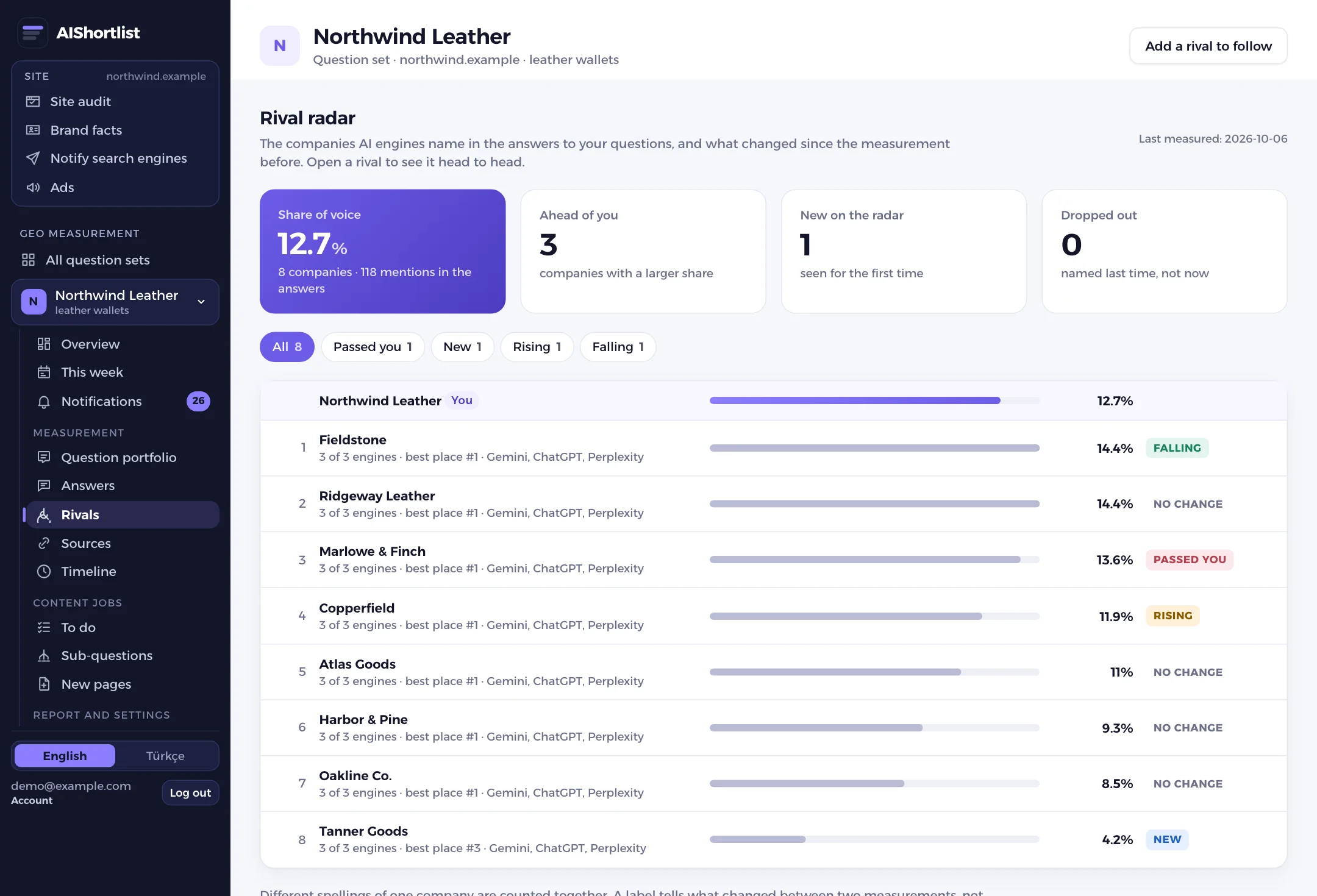
- Rivals: who leads on the same questions, with status labels.
- Question portfolio: the intent label and latest status of each question.
- Notifications and timeline: what changed from one measurement to the next.
Which two jobs should you do this week?
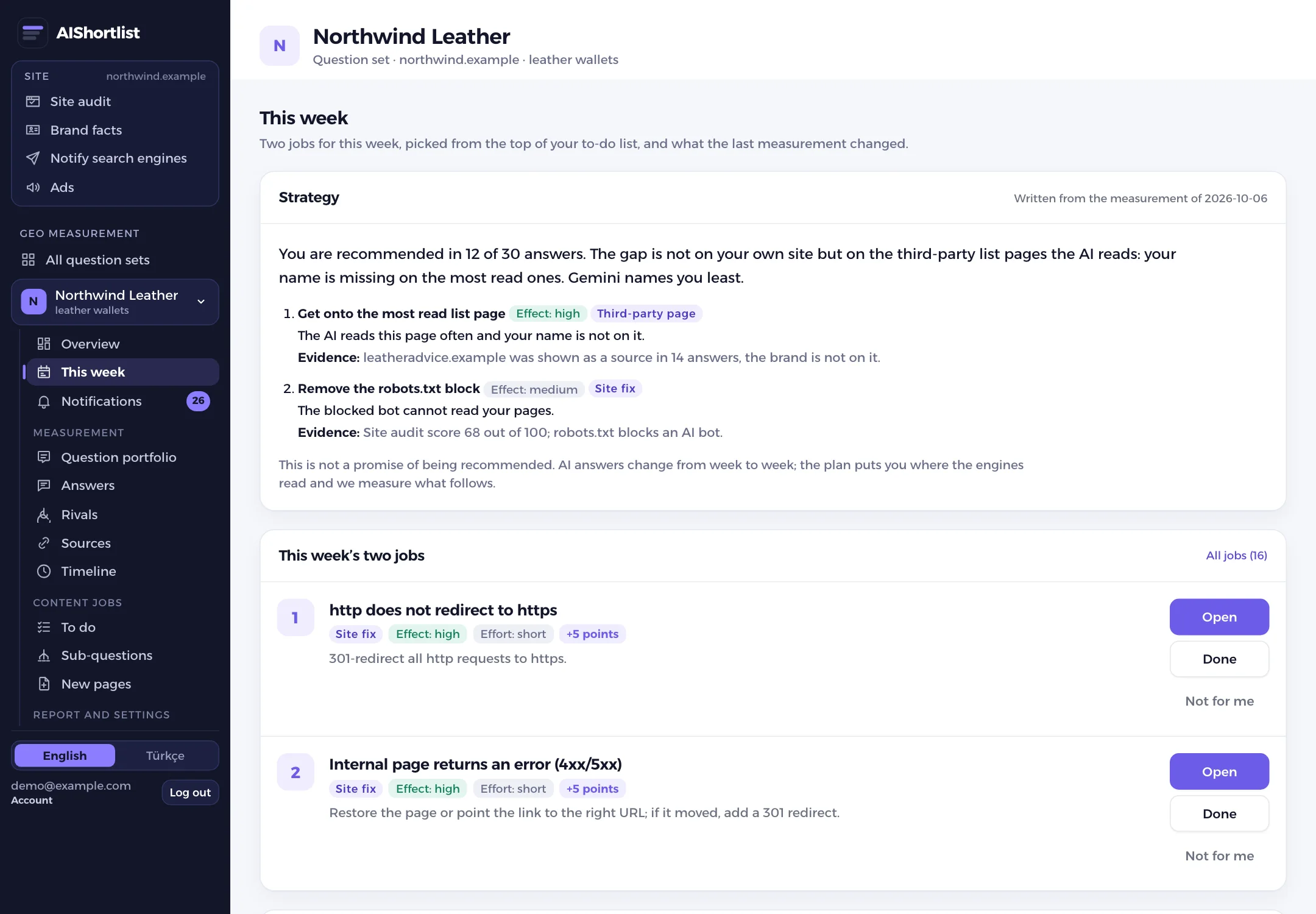
This week cuts the long list down to two: the two jobs with the highest effect, with the reason. Next to them is a short strategy summary written from the evidence of the last measurement.
- Strategy summary: where you stand and where the gap is, in at most five steps.
- The evidence for every step is the numbers and site names from the measurement.
- What the last measurement changed, at a glance.
The strategy summary is written by an AI model, but only from the evidence of the measurement. A step with a number or site name that is not in the evidence is dropped before you see it. It never writes score forecasts or guarantees.
Do AI engines describe your business correctly?
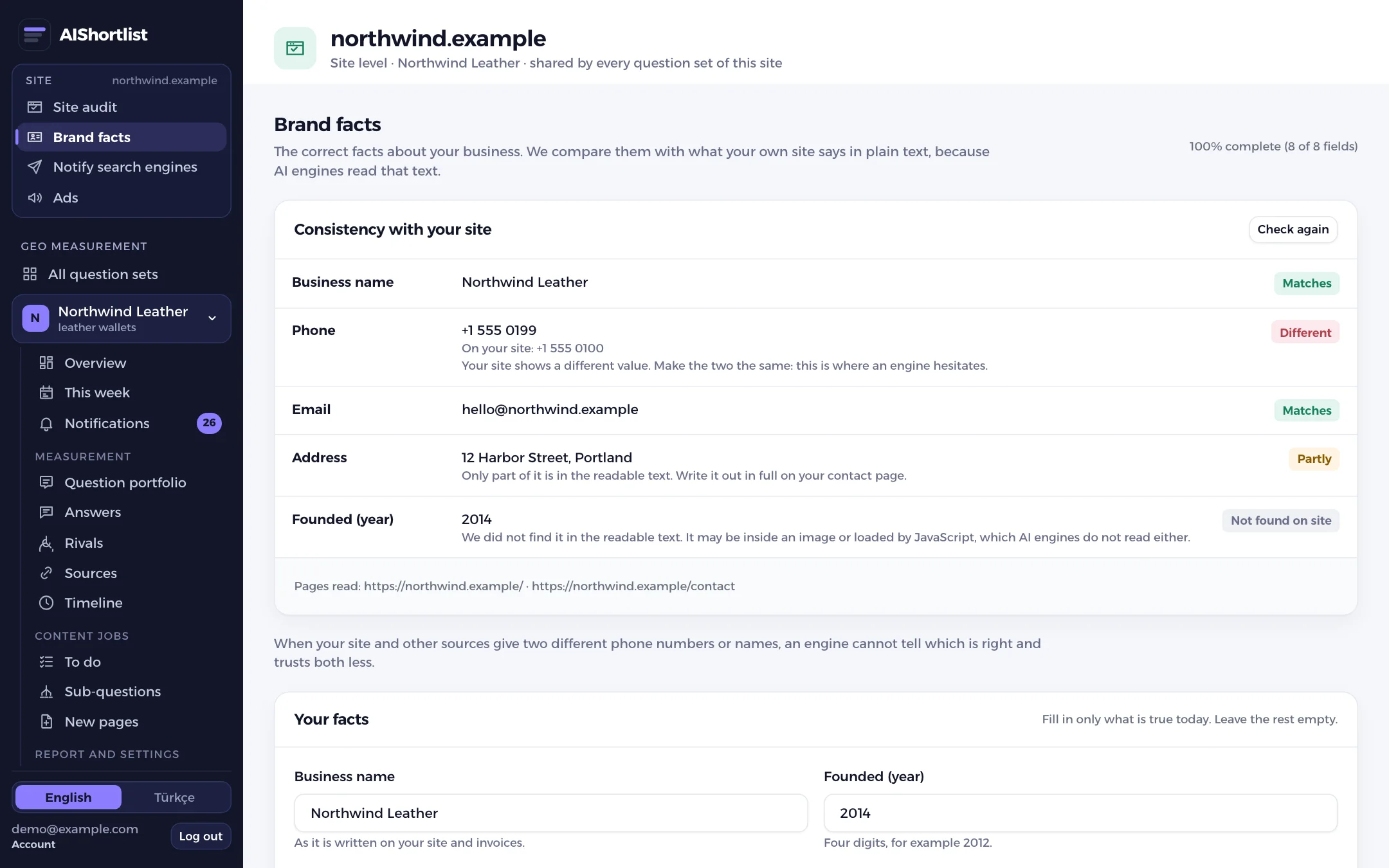
On Brand facts you type your phone, address, opening hours, founding year and services once. The dashboard first compares them with your site, then asks the engines.
- Consistency with your site: is what you typed the same as on your pages. No AI call, a direct text comparison.
- AI fact accuracy: what ChatGPT, Gemini and Perplexity say about your business, field by field: correct, wrong or unknown.
- Notify search engines: tell search engines about new or changed pages in one click (IndexNow).
The fact accuracy check is on paid plans: per 30 days, 1 on Lite and Starter, 2 on Growth, 4 on Pro, 10 on Agency.
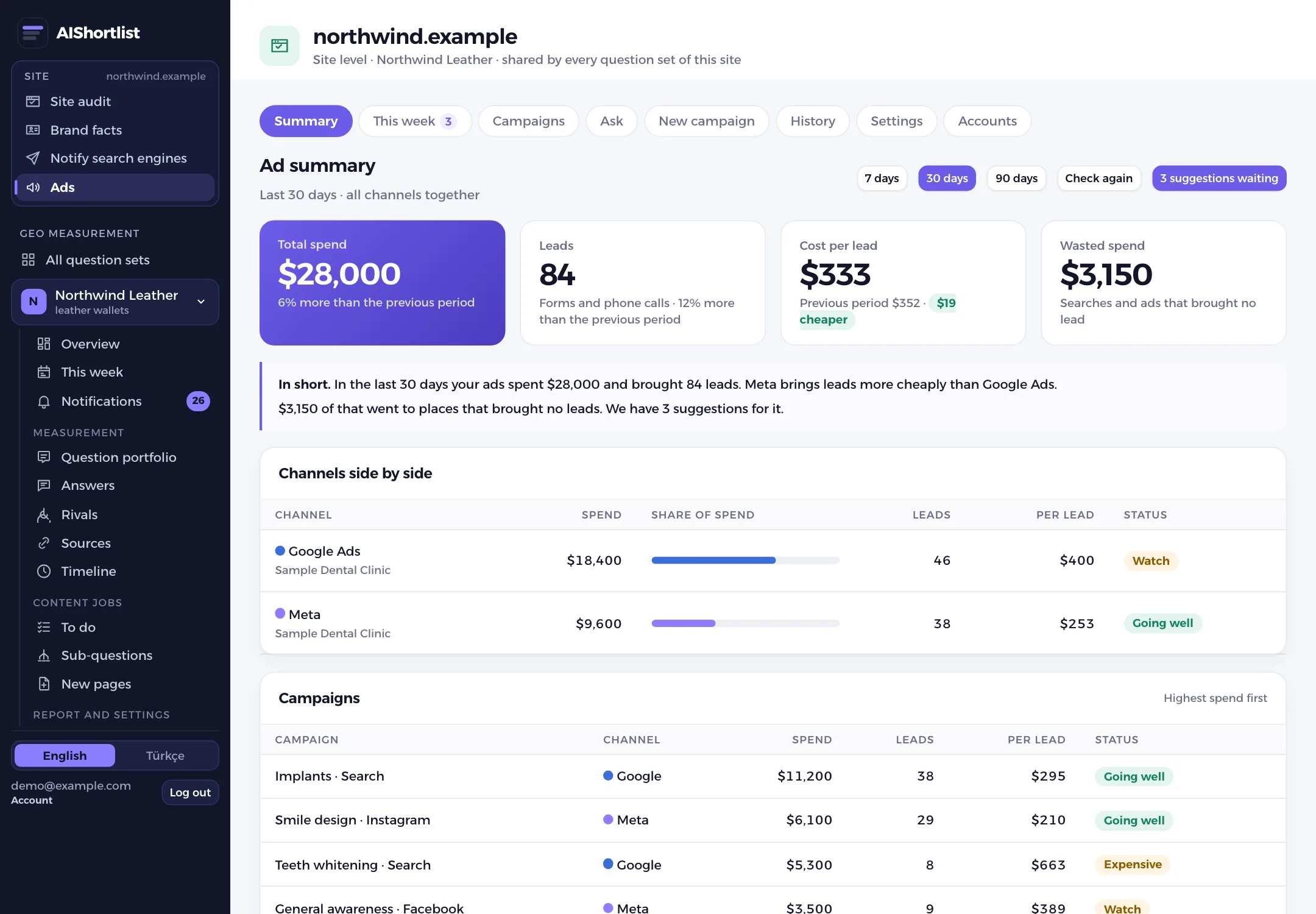
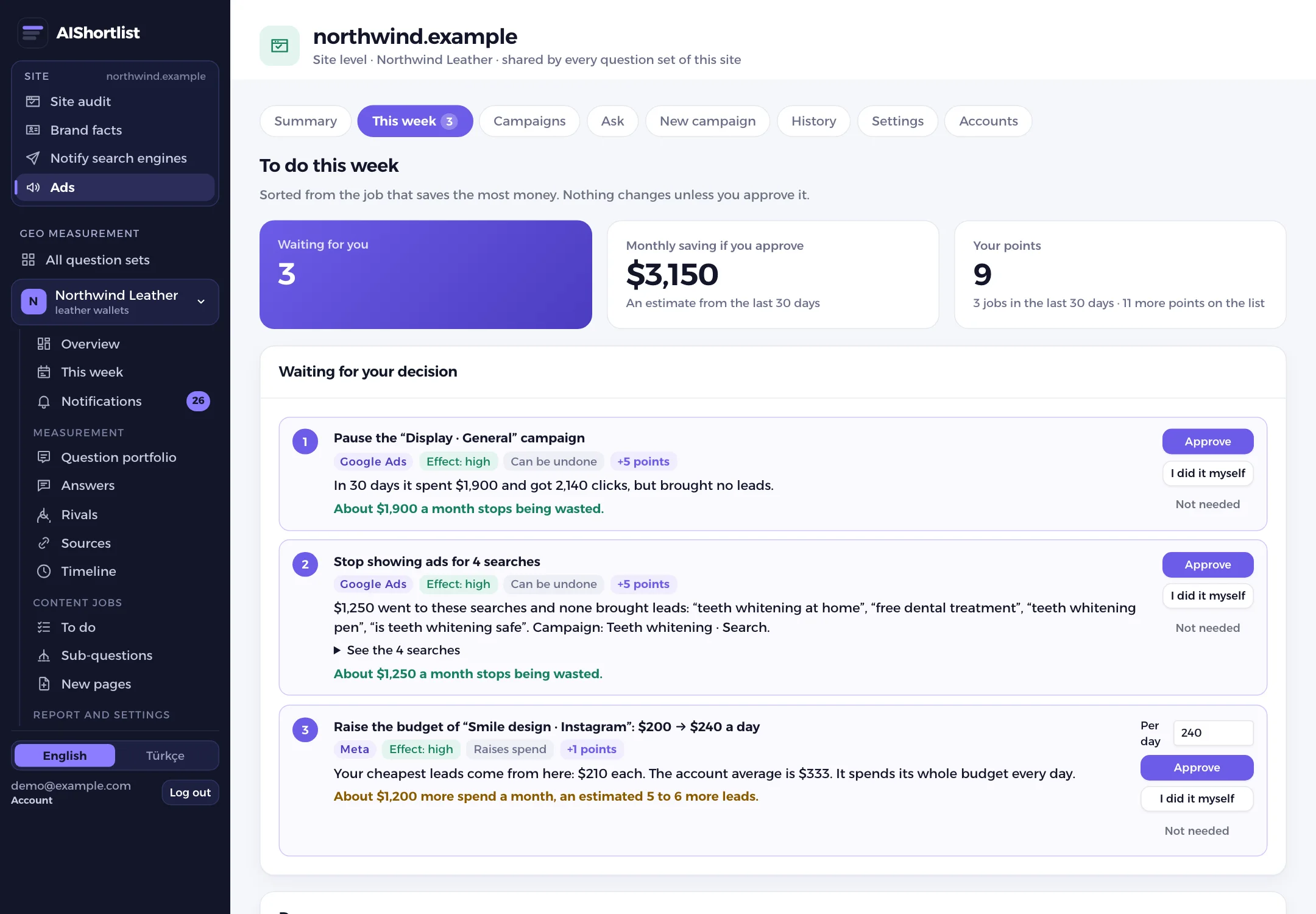
Your Google and Meta ads in the same dashboard
The Ads section reads your Google Ads and Meta ad accounts, sums up what your spend returned in plain language and makes suggestions every week. A suggestion you approve is applied to your ad account; nothing changes without your approval.
- Summary: spend, leads or sales, the cost of each and wasted spend.
- Suggestions: pause a campaign that brings nothing, exclude searches, add a search that works as a keyword, change a budget or a bid.
- Levels: ad groups and ad sets, ads, keywords and searches.
- Ask: type your question, the answer comes from your own account numbers.
- New campaign: an AI writes the texts, the campaign is created paused, you start it.
- Alerts: a Slack message when there are new suggestions.
Every change waits for your approval, is logged with the name of who approved it and can be undone. The Ads section is an add-on: $29 a month per site.
Why can you trust the numbers?
AIShortlist follows four rules. They are built into the product, not written on top of it.
Engines are measured separately
If one engine fails, that result is marked missing. We never fill the gap with another engine.
No guarantee of being recommended
Nobody can promise that. We measure honestly and show the steps that make it more likely.
Suggestions use only your facts
A passage is offered for replacement only if it is on your page word for word. Numbers that are not on your site are removed.
You approve every question
We suggest questions from your site. Measurement starts only after you approve the list.
See where you stand today
Create a question set, approve your questions and get your first result. Free, no card needed.