What do you see on the Competitors screen?
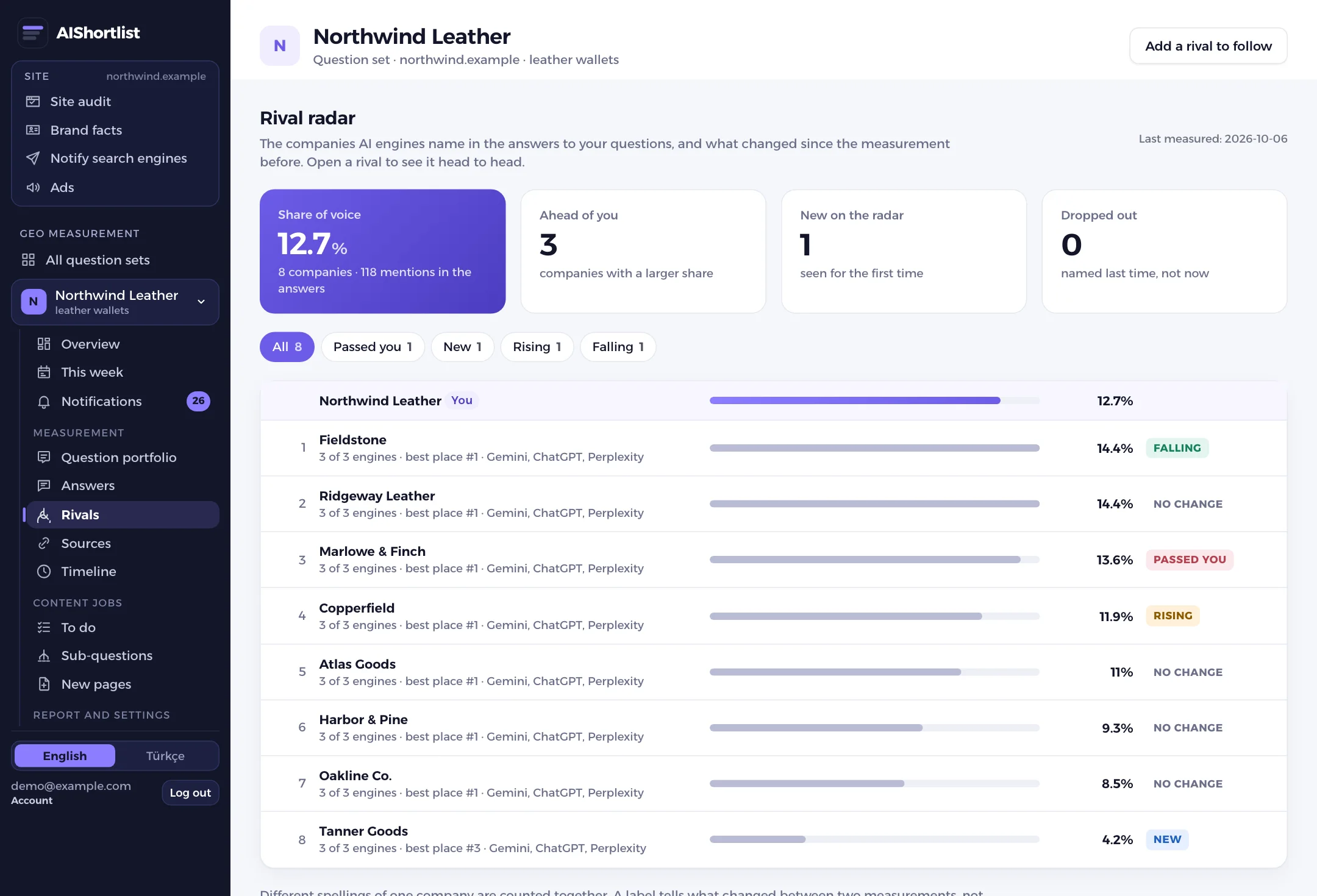
- The brands named in the answers to your questions, ordered by mention count.
- Each brand's share of voice and best position in the answers.
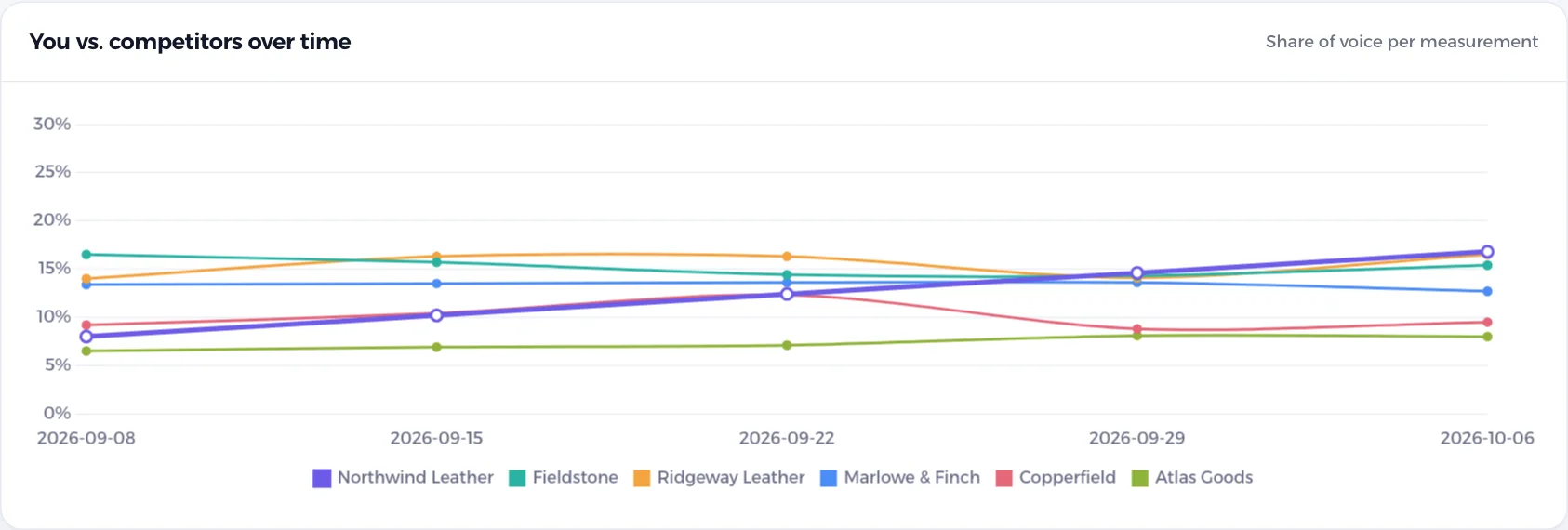
- A trend chart of the brands named most often alongside you, measurement by measurement.
- A status label next to each competitor: Overtook you, New, Returned, Rising, Fell, Disappeared.
- Which engine named whom instead of you, question by question.
How are competitors found?
You do not have to enter a competitor list. In each answer, the names other than yours are taken from the engine's list of companies. Company suffixes (Ltd, Inc, GmbH and the like) are dropped and different spellings of the same brand are merged.
That is why names you did not expect appear: brands you do not count as competitors but that AI recommends for your question. No second AI does the extraction; it is text matching.
How is share of voice calculated?
Share of voice is your mention count divided by the sum of your mentions and all competitor mentions in the answers. The denominator is every brand named in the answers, not only the top few.
Example: across 30 answers you are named 6 times and other brands 114 times in total, so your share of voice is 6 / 120, or 5 percent.
The visibility score answers a different question: the number of answers that name you divided by the number of answers measured. Your score can be high and your share of voice low: you appear in many answers, but each time inside a crowded list.
What do the competitor labels mean?
Labels are not a new measurement: the stored results of the last 12 measurements are compared, with no AI call.
| Label | When it is shown |
|---|---|
| Overtook you | The company's share rose above yours and was not above it in the previous measurement |
| New | Named for the first time in the last 12 measurements |
| Returned | Absent from the previous measurement, present in earlier ones |
| Rising, Fell | Its share changed by at least 1 percentage point, or its best position in the answers changed |
| Disappeared | Named in the previous measurement, not named at all in this one |
Limit: a label states the difference between two measurements, not the reason. AI answers also change on their own, so a single label is not a trend.
How do you find out when a competitor overtakes you?
The Notifications screen lists what changed after each measurement: a competitor that overtook you, questions won and lost, an engine that started or stopped naming you, sites cited for the first time.
On Growth and above, the "competitor overtook you" and drop alerts also arrive by email.
Scope and plans
The number of competitors shown in the radar depends on the plan: trial, Lite and Starter 3; Growth 10; Pro 25; Agency 50. The trend chart over time is open on paid plans.
Three engines are measured: ChatGPT, Gemini and Perplexity. Google AI Mode is not measured.